

BLOG - Adaptable activities for engaging the public with data research
Categories: Blogs, Public engagement
14 September 2026
Data research can be difficult to explain. Many concepts central to data research, such as data linkage, secure access, and public benefit, are often unfamiliar to people. Conversations can quickly become technical, making it harder for people to understand how data research relates to their lives. At Research Data Scotland (RDS) and ADR Scotland, we have found that one of the most effective ways to begin these conversations is through interactive public engagement activities that can be adapted to the audience and the research being shared. Over the last few years, we've developed a range of flexible public engagement activities designed to help people explore how data is used for research and become confident that all data is stored safely.
Rather than being designed around a single project, they can be adapted to different research topics, age groups, and settings. Each one aims to make complex ideas more accessible while creating opportunities for discussion.
Making the abstract tangible
One of our most popular activities invites participants to become data researchers themselves. In our LEGO® activity, participants apply for access to LEGO 'data', choose a researcher name, select datasets, and promise to keep that data safe. We then 'accept' the form before the participants use the LEGO to create something based on the information they have selected.
The activity introduces concepts such as accessing data, using secure environments, and linking data to answer research questions. The datasets can also be changed depending on the topic being discussed. This allows the activity to be used by other researchers and organisations to explain similar ideas.
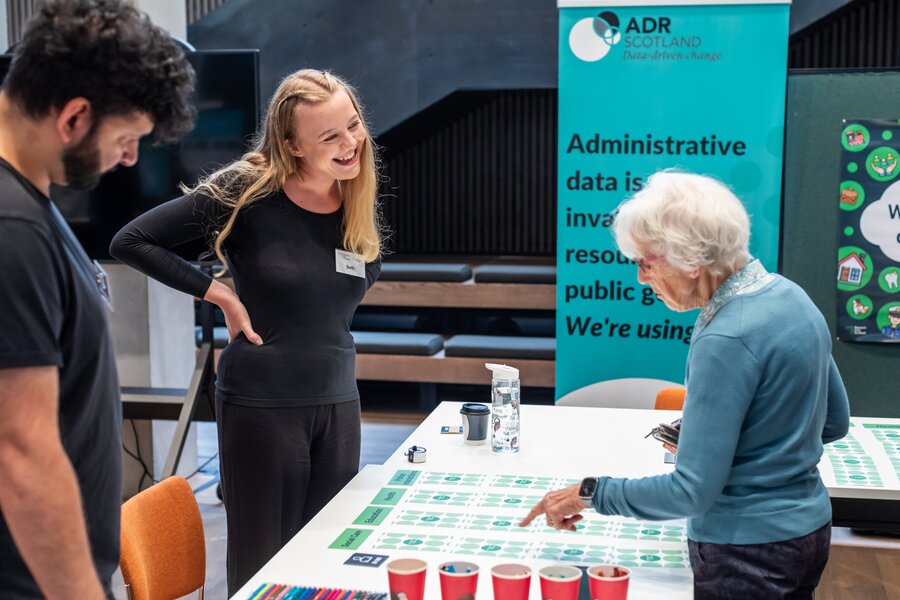
The same principle underpins many of our other activities. Our maze activity challenges children to identify the correct datasets to answer a research question, demonstrating how data can be linked together to generate new insights. Meanwhile, our card matching activity encourages older audiences to sort and connect datasets using anonymous identifiers, introducing the concept of data linkage and pseudonymisation in an accessible way. In both cases, the datasets and scenarios can be adapted whilst demonstrating the same underlying principles.
Exploring the barriers researchers face
Not all of our activities focus on how data is used. Some help explain the systems that exist to keep it safe. In our adapted version of Kerplunk, participants take on the role of people releasing data for research. The challenge is to remove barriers that researchers can face when accessing data, while recognising that some safeguards cannot and should not be removed. Through a simple game, families are introduced to the balance between enabling research and protecting information.
This often sparks valuable conversations about privacy, security and public trust. The barriers represented are common across many areas of data research. Therefore, the activity can be used to support discussions around a wide range of research projects while highlighting efforts to make data access more efficient, whilst maintaining security.
Showing how data reflects real life
One of our newest activities is a board game that follows the journeys of different characters. Data has shown that some communities face different opportunities and challenges than others. As players progress through the game, they begin to see how data can help us understand why some outcomes may be easier to achieve for some people than others.
Data does not decide someone's future, but it does help us identify inequalities. Understanding these inequalities can lead to better decision-making about how we might address them. The activity can also be adapted to reflect different research topics, with character backstories, destinations and barriers easily changed to communicate different types of research findings.
Creating opportunities for dialogue
Whilst the activities help attract attention, the most valuable outcomes are often the conversations that follow. For younger children, creative activities such as drawing, crafting, and colour-by-numbers provide a fun introduction to research questions while creating space for discussions with parents and carers. The colour-by-numbers activity reveals the answer to a research question as the picture is completed, turning data research into something visual and relatable. The research question and image can be changed to help reflect the topic being discussed.
For adults, we often use discussion-based activities such as our post-it note boards. These invite attendees to share their views on questions related to the research topic being explored at an event. The responses help us better understand public perspectives while creating opportunities for meaningful conversations about the role of data in society. Questions can be tailored to the event and the feedback being sought, making the activity a useful way of gathering views on a variety of research topics.
More than just activities
Public engagement activities are a great starting point for conversations about how data is used for public benefit, how it's kept safe, and why public views matter. Their flexibility means they can be used across a wide range of topics and audiences, allowing researchers and engagement professionals to reuse proven approaches whilst tailoring discussions to specific research questions. Every activity is designed with three key goals in mind. They must be engaging for the audience, adaptable across different topics, and help people to feel more confident talking about data research.
Interested by what you've read?
You can recreate or borrow these activities for use at engagement events or conferences.
Reach out to us at engage@researchdata.scot to request activity outlines or to loan out for your own work.