

BLOG: Making Data Make Sense: What did we learn from Edinburgh Science Festival?
Categories: Blogs, Public engagement
8 April 2026
How do you explain data science to someone who’s never heard of it, while competing with more tangible concepts like space, nature, and robots? Hear from Rachel Edwards about how she and the research team took on the challenge of 'making data make sense' at the Edinburgh Science Festival.
Over four days, Research Data Scotland, the Scottish Centre for Administrative Data Research (SCADR), and DataLoch worked with six research teams from the University of Edinburgh. Together, we created a range of interactive activities to help bring data research to life. What we found offered some useful lessons for our team and hopefully for others too.
Starting with curiosity
We engaged over 700 people at our stand, reaching almost a third of visitors to Dynamic Earth between 7th and 10th April. It was fantastic to speak to so many people, but what mattered even more than the numbers was how people engaged with us.
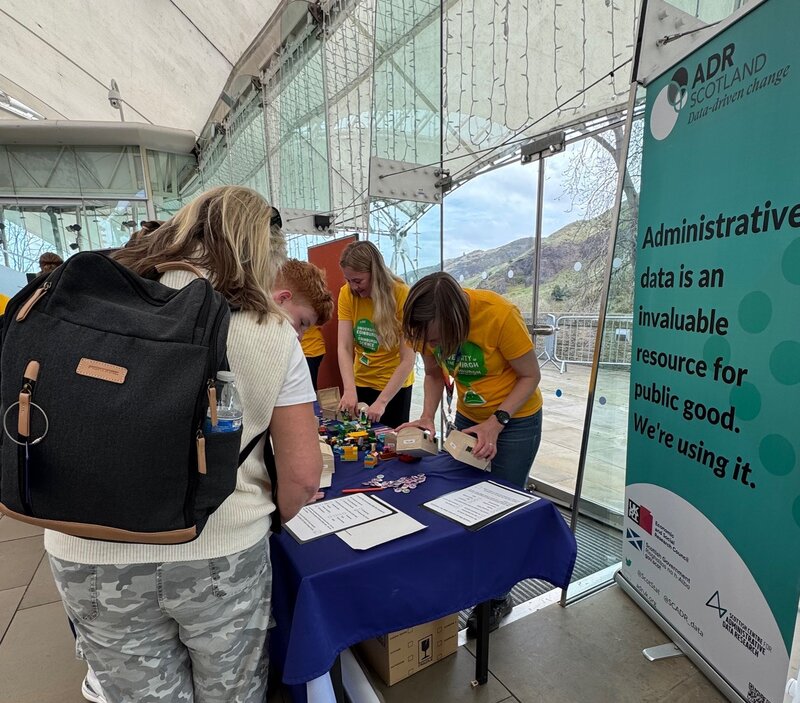
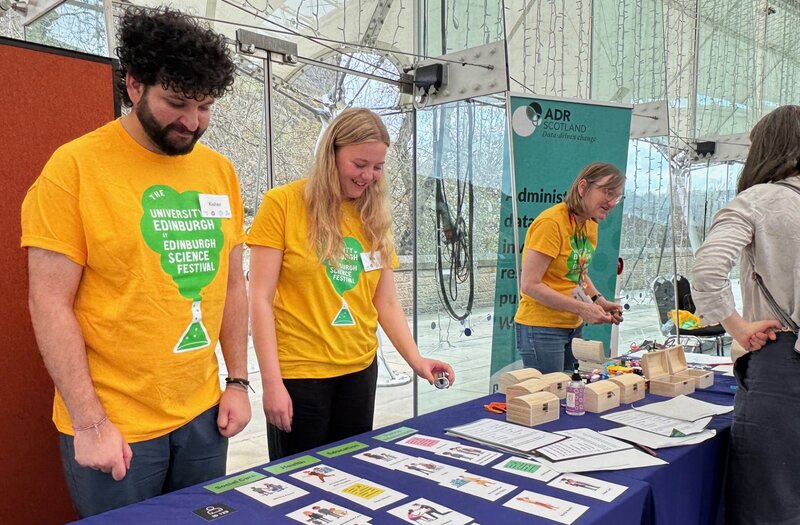
The most successful activities were the most inviting. Not everyone knows data, but they do know LEGO®, colour by numbers and crafts.
People didn’t initially visit our stand for the data. They visited us because they recognised what was on the table or were curious about what they saw. Who wouldn’t be curious about the metre-long clear plastic tube that people are blowing a mini football down?
In many cases, children started the activity, but adults stayed for the discussion.
Conversation is where the impact happens
It’s often assumed that festivals are for young people. They come and do the activities, and parents can have a break whilst their child lets off some steam. Though there were some cases of this, it was a rarity.
Researchers consistently found that activities acted as conversation starters, helping:
- Parents to explore complex data topics with their children
- Providing connection through lived experience
- Creating an informal space for feedback.
The main takeaway was that it’s not just an activity. It’s about supporting exploration through dialogue.
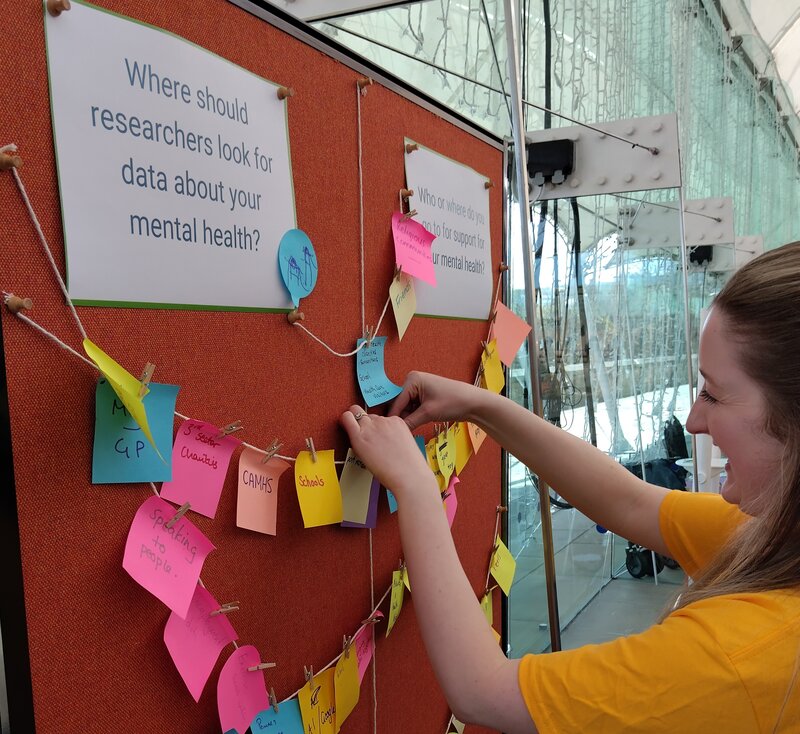
“It was really great to see how the parents were interacting with their children when doing the colour by numbers activity. The parents were facilitating conversations by asking the child what might affect their mental health, or who would they talk to about their mental health. “
Research Team member
Researchers want to get involved and felt the benefit
One of the most positive indirect outcomes was with the research teams themselves. They valued the chance to talk with the public, hear their perspectives, and get an opportunity to learn from those interactions.
Before the festival, some team members were unsure about the approach, so we set up training beforehand to support them. It was a chance to test the activities and practice interactions. With the comfort of this training, the teams realised the potential for public engagement to not just be an ‘add-on.’ It was a real chance to learn and explore with the public.
There were still challenges!
Explaining data concepts, especially data linkage was one of our biggest challenges. Even the most popular LEGO® activity led to confused stares if the explanation took more than a minute.
This was especially true for younger audiences, leading to a clear lesson — if it takes more than a few sentences to explain, it’s probably too complex for this setting. Clear metaphors and simple messaging are essential.
We also found that whilst engagement was high, capturing feedback was much harder. We already knew that traditional feedback forms were hard to encourage people to complete at these types of events. So, we tried stickers on simple feedback form sheets instead. Unfortunately, we found it had low participation, inconsistent and unreliable responses.
Reaching new audiences
Despite minor drawbacks, it was encouraging to see we weren’t just speaking to the ’already engaged’. Accounting for the issues on the feedback forms, we still found almost two thirds of respondents reported little or no prior knowledge of data before visiting us.
Through conversations, we also noted a diverse, international festival audience, which reinforced the value of taking research into public spaces, something the Edinburgh Science Festival excels at.
“What really struck me about the day was the level of bustling energy in the room. Children and parents alike really engaged with the activities. Often the children would be immersed in the activity in front of them, be it LEGO® or colouring, which gave the adults some time to have a more in-depth chat about the nub of the matter - the data. Hats off to Rachel and the researchers for delivering a busy, non-stop event!”
Dr Janice Murray, Engagement Lead, ADR Scotland
Looking Ahead
Data is having a growing impact on the world around us. ADR Scotland, in particular, Research Data Scotland and SCADR, plus DataLoch, are all trying to help researchers access data about the public for their benefit. However, many members of the public don't even know it’s being used. We have an obligation to raise awareness and understanding with the public and to create informal spaces to talk to them about any questions or feedback they have.
Our time at Edinburgh Science Festival shows that when you make data interactive, relatable, and accessible, people want to talk about it. We look forward to planning how we take our future engagement to the next level.
Author: Rachel Edwards, Public Engagement Officer for Research Data Scotland, delivery partner of ADR Scotland