

BLOG - Why science festivals matter for public engagement with data research
Categories: Blogs, Public engagement, Events
3 September 2026
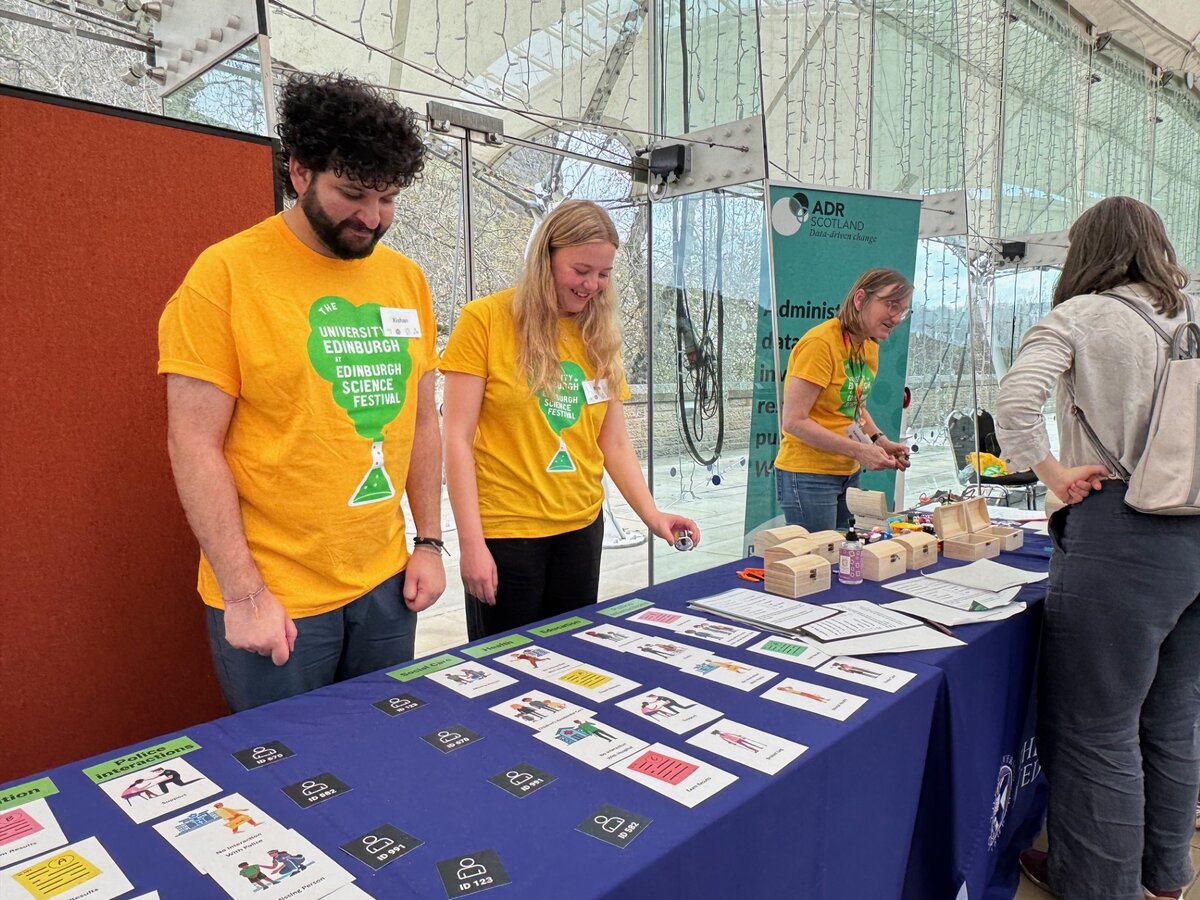
Why science festivals matter for public engagement with data research
Over the last two years, Research Data Scotland (RDS) and Administrative Data Research Scotland (ADR SCOTLAND) have attended public engagement events with partners across Scotland. We went with one question in mind: Can public engagement events help people better understand data research and its role in society?
Between September 2024 and April 2026, we engaged with more than 1,500 people across five public-facing events.
What we found was encouraging:
- People are interested in data research.
- People value of face-to-face engagement
- They appreciate opportunities to ask questions, share their views and understand how data is used for public benefit.
Creating space for conversations
While activities helped attract people to our stalls, the real impact often came from the conversations that followed.
Parents, grandparents and carers frequently took the opportunity to speak with staff and researchers while children were taking part in activities. These conversations ranged from questions about data security and privacy to discussions about how research can help tackle real-world challenges.
Many attendees told us they appreciated being able to speak directly with people working in research and it also led to some surprising benefits for attendees we hadn’t anticipated.
I’m a teacher and I love seeing the creative ideas at these events and like it to inspire my own work.
Attendee at Glasgow Science Festival
Comments like these remind us that data research is not an abstract concept. For many people, it relates directly to their experiences, families, and communities.
Reaching people who are new to data
Across the events, a large proportion of attendees told us they had heard little or nothing about data before visiting our stalls. In fact, 64% of respondents across the later events said they knew little or nothing about data research before engaging with us.
Data research can often feel technical and abstract from everyday life. Science festivals provide a space where people can encounter these discussions in an informal and welcoming environment that shows the relevance of the work.
Along the way, we learned that partnering researchers brought the data to life. Parents and guardians regularly wanted to hear about real projects, and what questions data can help answer. ADR Scotland researchers who joined us at events explained how their research had to benefit the public, before it gets approved. They frequently discussed their work directly with the public, informing them when their project's outputs have influenced policy that brings benefits to the public.
I think all activities worked well, especially having the post-it notes in the centre of the table which gave you a talking point to start a conversation with the adults whilst the children were taking part in the activities.
Research Staff Member, Edinburgh Science Festival
What we learned
Interactive and visual activities consistently attracted the highest levels of attention, whilst creative and hands-on experiences kept people there. These experiences also aided in helping the audience interact with data in ways that felt more relevant to their lives.
Once people got involved, they engaged with the activities in different ways. Younger children were naturally drawn to crafts and colouring activities, while adults often preferred discussion-based engagement. Teenagers were noticeably harder to reach, suggesting we need to think differently about activities aimed at this age group.
Finally, we learned that success cannot be measured solely through newsletter sign-ups or website visits. Some of the most valuable outcomes were the conversations themselves and the moments of learning they created. In future we hope to capture these better.
I remember one parent being grateful that there was no time limit on these activities; one child stayed for about an hour trying out all the different activities.
Staff Member, Dundee Science Festival
What happens next?
The findings from our pilot programme have directly informed our plans for the next two years.
Our priority continues to be reaching people who are less likely to engage with data research or science in general. However, we are very keen to expand by attending more local community events, strengthening partnerships with community organisations, and increasing our presence outside Scotland's central belt.
We also want to improve how we evaluate our events. Our future engagement activities will also include new methods to record and better understand: who we are reaching, what people learn, and which approaches are most effective.
Another key area of focus will be creating clearer pathways for ongoing involvement. Rather than focusing primarily on newsletter sign-ups, we want to help people discover opportunities to get involved in public panels, engagement activities and future conversations about data research.
Public engagement is not simply about sharing information. It is about creating opportunities for dialogue, learning, and trust.
Our experience has shown that when people are given the space to explore, question and discuss data research, they are eager to take part. As we move into the next phase, we will continue building on this and ensure that public perspectives remain at the heart of what we do.
Future engagement event
We look forward to meeting many of you at Doors Open Day, Saturday 26th September, at the Bayes Centre in Edinburgh to experience our activities in person.