

BLOG: Data for a Fairer Future: Reflections from Pint of Science 2026
Categories: Blogs, News, Blogs: ADR Scotland
3 June 2026
ADR Scotland was delighted to support “Data for a Fairer Future”, part of this year’s Pint of Science festival in Edinburgh — an event that brought research on inequality, education, and transport into an informal, and lively setting.
I had the pleasure of opening the evening with a short introduction to ADR Scotland, setting the scene for how administrative data can be used to better understand social challenges and inform more effective policy and practice.
Hosted at the Old Bell Inn, the event highlighted the value of creating space for open conversation between researchers and the public. By moving beyond traditional academic environments, events like this allow data-driven insights to reach wider audiences — and invite meaningful conversation in return.
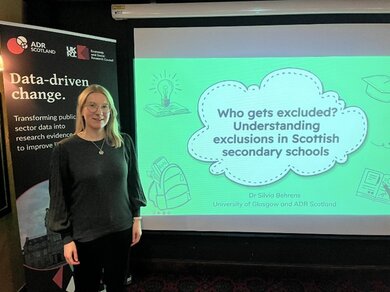
Who gets excluded? Understanding exclusions in Scottish secondary schools
The first talk was presented by Dr Silvia Behrens. Silvia explored patterns of exclusion in Scottish secondary schools, highlighting how administrative data can uncover inequalities that are not immediately visible in headline statistics. While overall exclusion rates provide a useful starting point, looking more closely at the data reveals important variations such as differences across pupils and their backgrounds, the influence of policy and place and, perhaps most surprising to me, the variation between schools and local authorities.
Silvia’s presentation reinforced the importance of linked data in helping us better understand how systems, in this case the criteria for a pupil to be excluded from school, operate in practice — and where they may disproportionately impact pupils with certain characteristics.
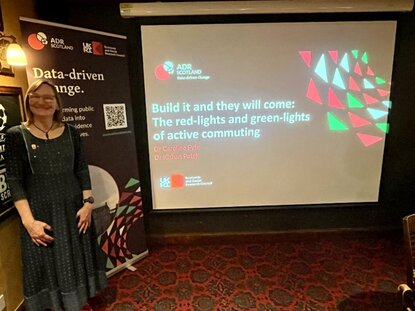
Build it and they will come: Can improving access to cycleways encourage more Scots to cycle commute?
The second presentation was an academic double act, with Dr Caroline Fyfe and Dr Kishan Patel discussing how infrastructure can shape commuting choices, focusing on cycling as a mode of transport.
Using linked administrative data, the research explored how access to cycleways influences uptake, particularly among underrepresented groups. Caro and Kishan’s research suggests that infrastructure plays a key role in making it easier for people to get involved in active travel, something of particular relevance in a hilly city such as our own!
The Value of Public Engagement
A real highlight for me was the amount of audience engagement. The venue and setting really lent itself to a relaxed and casual evening with a lot of audience discussion. Most of the questions were addressed throughout the evening but we did have some which were posed online as we ran short of time.
Understanding Infrastructure and Place:
Where are the cycle paths concentrated? Are they evenly built-in areas of different levels of deprivation?
This question highlighted the differences between areas across cities. After the event I posed this to Caroline- “Initial analysis suggests no single, consistent pattern in how cycle infrastructure is distributed across areas of differing deprivation”. Instead, the discussion pointed to the role of practical constraints — such as available space and existing transport corridors — in shaping where infrastructure is delivered.
Gaps in Data and Emerging Trends
Participants also raised questions about how emerging trends — such as the growth of e-bikes and cargo bikes — may affect commuting behaviour.
Currently, key datasets such as the census do not distinguish between types of bicycles, limiting our ability to fully understand these shifts. This highlights an opportunity for future data collection to better reflect changing behaviours and technologies.
Interpreting Impact
Questions about whether cycle lanes improve traffic flow and reduce congestion showed how hard it is to prove cause and effect in real life. Caroline says “Travel behaviour is influenced by multiple factors, including policy changes (such as free bus travel for under-22s), and varies significantly over time”.
Continued analysis, including comparisons between the 2011 and 2022 Census, will hopefully help build a clearer picture of how commuting patterns are evolving.
Informing Better Decisions Through Data
Across both talks and the discussion, a consistent message emerged: data can help us better understand how systems are experienced — and where there are opportunities to improve outcomes.
Equally, the conversation highlighted that data rarely provides simple answers. Instead, it enables more informed questions — an essential step in designing effective, inclusive policies.

Looking Ahead
Events like Pint of Science play an important role in connecting research with the communities it ultimately serves. For ADR Scotland, supporting opportunities to share insights, gather feedback, and encourage dialogue is a key part of our mission.
We would like to thank the speakers, organisers, and attendees for an engaging and thoughtful evening — and we look forward to continuing these conversations in future.
Meet you in the pub next year?
Author: Dr Janice Murray
