

Data Insight: From nursing degree to employment: what happens to people studying nursing in Scotland?
Categories: Research using linked data, Data Insights
12 October 2026
Ensuring the sustainability of the nursing profession is a key element of health and social care delivery. Likewise, endeavouring to ensure those qualifying have jobs ensures both effective use of resources and fairness to those who have spent at least three years achieving their registration. This data insights asks if those setting out on a degree achieve their qualification, and if those doing so obtain a job in their first year as registrants.
Using linked universities and HMRC data, analysis finds that between 2004/05 and 2015/16 more than nine in ten (93%) completed their course, and over 90% of those were in sustained employment in their first-year post studies.
Of those in sustained employment, around two thirds (67%) were employed by organisations classified as “hospital activities” (most likely as nurses). Others were employed across a wider range of health, social care and other settings, including “other human health activities”, “residential nursing care” and “general practice”.
For the cohorts studied, progression through nursing education and into employment was high. This suggests very effective use of resources. It also reassures would be nurses towards setting out on a nursing career. Conversely, there was limited scope to substantially increase nursing workforce supply through improvements in course completion or the initial transition into employment.
What We Did
We used the Scottish Longitudinal Education Outcomes (Scottish LEO) University dataset, which links Higher Education Statistics Agency (HESA) student records with administrative employment and earnings data from His Majesty’s Revenue and Customs (HMRC).
HESA records were used to identify people who started pre-registration nursing programmes and whether they completed their course, while linked HMRC Pay As You Earn (PAYE) records were used to examine employment after study.
The analysis included people who started a pre-registration nursing qualification at a Scottish higher education institution between 2004/05 and 2015/16. We focused on whether students completed their nursing course and, among those who completed, whether they were in sustained employment one year later and the types of organisations employing them.
For this analysis, sustained employment was identified from HMRC employment records. The PAYE component of the Scottish LEO sustained-employment measure identifies people who were employed for at least one day in five of the six months between October and March of the relevant tax year. People who did not meet the definition were not necessarily unemployed throughout the year; they may, for example, have worked for shorter periods or followed other pathways.
We used Standard Industrial Classification (SIC) codes to describe graduates’ employment destinations. SIC codes classify organisations according to their main economic activity, allowing us to distinguish between employers classified under hospital activities, residential nursing care, employment agencies and other sectors. SIC describes the employer rather than the individual employee’s occupation, so these data cannot tell us whether a graduate was working specifically as a registered nurse.
What We Found
Most people who started a nursing course completed it.
Of the 37,343 people who started a pre-registration nursing qualification, 34,723 (93%) finished their course. A field of nursing was recorded for 68% of those who completed, compared with 42% of those who did not complete their course.
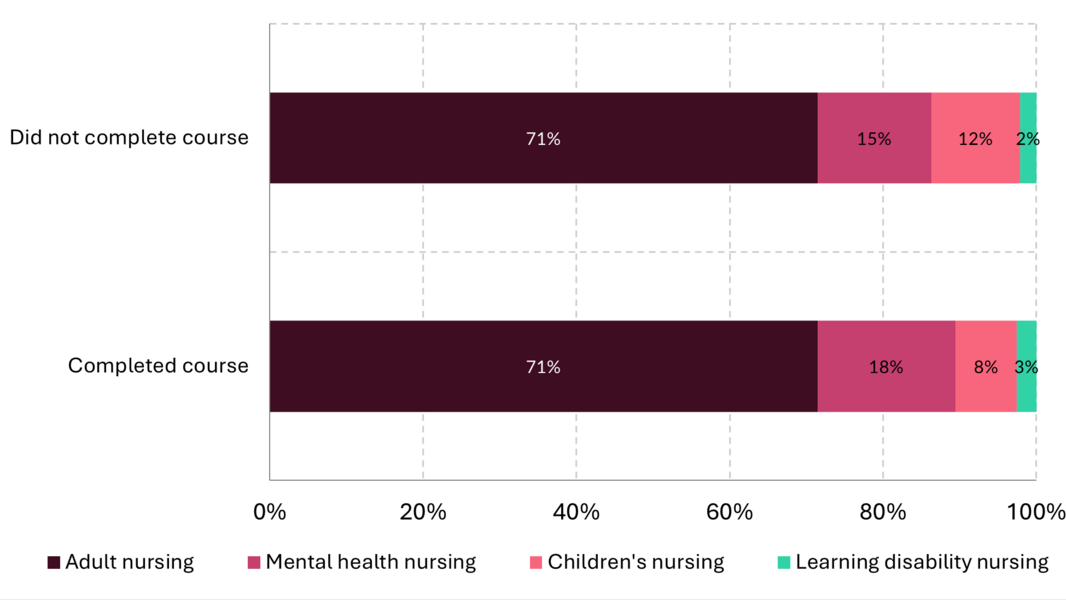
Among those who completed and had a field recorded, 71% were studying adult nursing, 18% mental health nursing, 8% children’s nursing and 3% learning disability nursing (Figure 1). Because speciality information was missing more often among those who did not complete their course, these figures should not be interpreted as showing differences in completion rates between nursing specialities.
Figure 1: Recorded nursing speciality by course completion status1
The transition from nursing education into employment was also high. Of the 34,723 people who completed their course, 31,656 (91%) were in sustained PAYE employment one year later. The remaining 9% did not meet the definition of sustained PAYE employment. This should not be interpreted as an unemployment rate: some may have worked for shorter periods or followed other pathways.
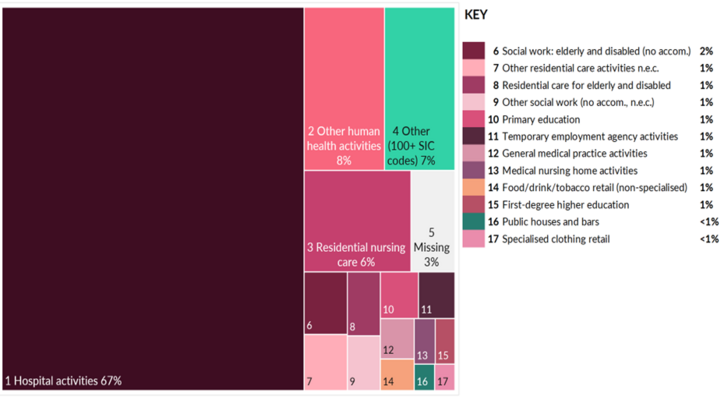
“Hospital activities” accounted for most recorded employment destinations (Figure 2). Among all 31,656 graduates in sustained PAYE employment, around two thirds (67%) were employed by organisations classified under “hospital activities”, 8% under “other human health activities” and 6% under “residential nursing care facilities”. Together, these three categories accounted for just over four in five graduates in sustained employment. Further, 1% of graduates found employment through “temporary employment agencies”, with smaller proportions spread across social care, general medical practice, education, retail and more than 100 other SIC categories. SIC information was missing for around 3%. Percentages use all graduates in sustained PAYE employment as the denominator, including those with missing SIC information.
Figure 2: Employment sectors of nursing graduates in sustained employment one year after course completion1
In summary, our findings therefore show a strong initial transition from nursing education into employment, but also that employment was not confined to hospital organisations. Notably, most graduates were working in areas commensurate with what might be expected of someone with a nursing degree. Few were taking up jobs outside of health and social care.
Why it Matters
Scotland continues to face challenges in recruiting and retaining enough nurses to meet demand across health and social care. The Scottish Nursing and Midwifery Taskforce has identified education, recruitment, retention and workforce development as priorities, while the Nursing 2030 Vision emphasises the need for a workforce able to respond to changing patterns of care (Scottish Government, 2017; Scottish Government, 2025).
For the cohorts studied, the transition through nursing education and into employment was reassuring. More than nine in ten people who started a pre-registration nursing course completed it, and a similar proportion of those who completed were in sustained PAYE employment one year later. This suggests there may be limited scope to substantially increase workforce supply by focusing on course completion or the initial transition into employment alone. Generally, this is good news with regard to the investment in nursing resulting in an efficient pipeline to registration. It also suggests that studying the subject is likely to result in completion and employment.
The results also show that nursing graduates were employed across a broader range of settings than hospitals alone. Around one third of graduates in sustained employment were employed outside organisations classified under hospital activities, including other health services, residential care, social care, general practice, education and other sectors. This reinforces the need for nursing education to prepare graduates to work flexibly across different parts of health and social care, rather than assuming a single hospital-based career pathway.
These findings should also be interpreted in their historical context. The analysis covers people who started nursing courses between 2004/05 and 2015/16, and their early employment outcomes, therefore largely pre-date the COVID-19 pandemic. The pandemic, subsequent workforce pressures and changes in how health and care services are organised may have altered graduate pathways since then. These results are therefore best viewed as a pre-pandemic baseline against which more recent patterns can be compared.
What's Next
The next step is to follow nursing graduates over a longer period. Scottish LEO makes it possible to examine whether graduates remain in the same parts of the labour market, move between different health and care settings, enter healthcare after initially working elsewhere, or move out of healthcare over time.
This matters because a high rate of employment one year after course completion tells us relatively little about retention. Following graduates across subsequent tax years would show whether the strong initial transition into employment is sustained and where nursing graduates contribute to the health and care workforce over the longer term.
Analysing more recent cohorts would also show whether the patterns observed in these largely pre-pandemic cohorts have persisted following the substantial changes experienced by health and social care since 2020.
References
ADR UK (2026) Scottish Longitudinal Education Outcomes (LEO) – University extract. Available at: https://www.adruk.org/data-access/flagship-datasets/dataset/scottish-longitudinal-education-outcomes-leo-university-extract/ (Accessed: 28 September 2026).
Office for National Statistics (2009) UK Standard Industrial Classification of Economic Activities 2007 (SIC 2007). Available at: https://www.ons.gov.uk/methodology/classificationsandstandards/ukstandardindustrialclassificationofeconomicactivities/uksic2007 (Accessed: 28 September 2026).
Royal College of Nursing (2025) The Nursing Workforce in Scotland 2025. Available at: https://www.rcn.org.uk/About-us/Our-Influencing-work/Policy-briefings/The-Nursing-Workforce-in-Scotland-2025 (Accessed: 28 September 2026).
Scottish Government (2017) Nursing 2030 Vision: Promoting Confident, Competent and Collaborative Nursing for Scotland's Future. Edinburgh: Scottish Government. Available at: https://www.gov.scot/publications/nursing-2030-vision-9781788511001/ (Accessed: 28 September 2026).
Scottish Government (2018) Longitudinal Education Outcomes (LEO) from Universities: 2015-16: Scotland – Methodology. Edinburgh: Scottish Government.
Scottish Government (2025) Ministerial Scottish Nursing and Midwifery Taskforce: Report and Recommended Actions. Edinburgh: Scottish Government. Available at: https://www.gov.scot/publications/report-recommended-actions-ministerial-scottish-nursing-midwifery-taskforce/ (Accessed: 28 September 2026).