

Data Insight: Understanding factors linked to school absence in Scotland
Categories: Data Insights, Children, young people & education
10 June 2026
This Data Insight by Dr Silvia Behrens analyses data relating to school absence among secondary school pupils in Scotland.
Summary
This Data Insight examines factors linked to higher levels of school absence among secondary school pupils in Scotland. The analysis finds that :
- Pupils from low-income households are twice as likely to miss 10% or more of the academic year (a widely used measure of persistent absence).
- Additional support needs (ASN) and mental health difficulties are also strongly associated with missing school.
- Authorised absences are more common among pupils with health-related needs, while unauthorised absences are strongly linked to poverty, care experience and social-emotional difficulties.
- Poverty and emotional wellbeing, especially in combination, have negative effects on school attendance (Behrens et al., 2026).
What we did
We used linked administrative data from Scotland to investigate factors linked to school absence in secondary education. The data included school attendance records, demographic information from the Pupil Census, information on long-term health conditions of children and parents from the 2011 Census, and prescription medication used in mental health. Some of these prescriptions may not be exclusively prescribed for mental health diagnoses but also for other health indications (Public Health Scotland, 2021).
Our analysis covered all pupils from secondary stage 1 (S1) to secondary stage 6 (S6) at public schools in Scotland during the 2014/15, 2016/17 and 2018/19 academic years.
We were interested in three outcomes:
- whether a pupil was persistently absent (defined as missing 10% or more of the academic year) and the probabilities of persistent absence by school stage and pupil characteristics;
- the association between authorised absence, school stage and pupil characteristics;
- the association between unauthorised absence, school stage and pupil characteristics.
In Scotland, schools typically run for 380 half-day sessions in an academic year (equivalent to 190 full days). Authorised and unauthorised absence refer to categories set out in Scottish Government guidance (Scottish Government, 2019).
We examined how absence patterns related to a range of pupil and family characteristics varied.
These included:
- socioeconomic disadvantage (measured through free school meal registration),
- care experience,
- additional support needs (ASN),
- a record of mental health related prescriptions, and
- long-term health conditions reported by children and parents.
What we found
The proportion of secondary school pupils missing at least 10% of the school year has increased over time. Around one in four pupils missed at least 10% of the school year in 2014/15. By 2018/19, it was nearly one in three. Absence rates rise as pupils moved through and into the later stages of secondary school, particularly from S3 to S5. This pattern is likely further influenced by the fact that compulsory education in Scotland ends after S4.
The biggest difference in persistent absence is linked to household income. Pupils who had ever been registered for free school meals had an up to 44% probability of being persistently absent. This means pupils from low-income households were about twice as likely to miss 10% or more of the school year than their peers.
Additional support needs, which in Scotland cover a wider range of needs than Special Educational Needs and Disabilities (SEND) in England, were also linked to higher levels of persistent absence. Pupils with recorded support needs had a 31-35% probability of persistent absence, compared with 22-25% for pupils without support needs. This means pupils with support needs were around a third more likely to be persistently absent, although the gap was still smaller than the much larger difference associated with household income.
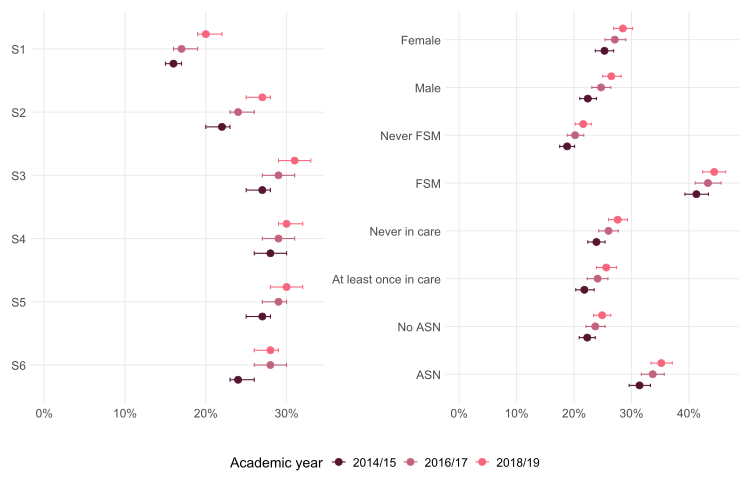
Figure 1. Probabilities of being persistently absent by educational stage and pupils’ characteristics.
Most of the variation in authorised absence (99.7%) and unauthorised absence (97.7%) occurred within schools, which indicates only very small differences between schools or local authorities. This contrasts with exclusions where school‑level and local authority-level variation is more pronounced (Troncoso et al., 2024).
For authorised absence, pupils from low‑income households had around 50% more authorised half‑days of absence than their peers. For example, if a typical pupil had 20 authorised half‑days of absence (equivalent to 10 full days), a pupil from a low‑income household would have around 30 authorised half‑days. Mental health-related prescriptions were also strongly linked to authorised absence: pupils who had ever received such prescriptions had almost twice as many authorised half‑days of absence as those who had never been prescribed any.
Unauthorised absence showed a different pattern. It increased as pupils moved through secondary school, with the highest rates in S5 and S6. Socioeconomic disadvantage, again, played a major role: pupils who had ever been registered for free school meals had noticeably more unauthorised absences. For example, in some years they missed around one to three more half‑days without a recorded reason than pupils who had never been registered. For pupils with social‑emotional needs, this gap widened further, with pupils missing around nine to eleven more half‑days of school without a recorded reason than their peers.
These patterns were consistent across all three academic years.
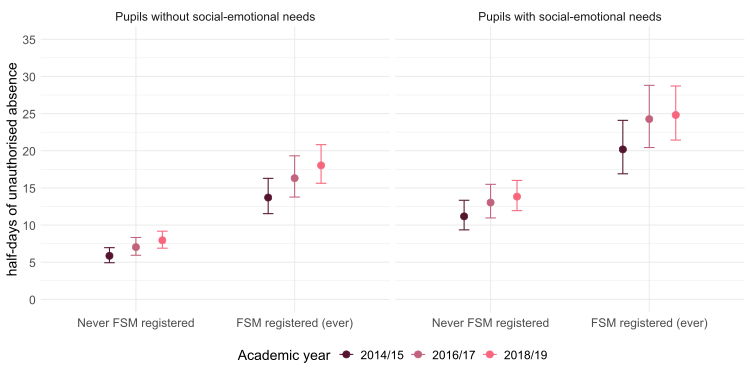
Figure 2. Estimated half-days of unauthorised absence by FSM registration and social-emotional needs.
Note: results are conditioned on 380 half-days of possible school attendance at stage S3, with other covariates held at their population-level.
Why it matters
Understanding why pupils miss school is important because school absence can reflect wider inequalities in children’s lives.
This research shows that patterns of persistent, authorised and unauthorised absence are shaped more strongly by pupils’ circumstances than by differences between schools. These findings point to structural issues that affect whether pupils attend school, some of which may not be resolved by schools alone.
Other research has also evidenced that poverty negatively affects parents’ and children’s mental health (Treanor & Troncoso, 2022) and that long-term physical, neurodevelopmental and mental health needs are linked to higher levels of school absence (Finning et al., 2022).
Socioeconomic disadvantage shows a consistent association with absence across all three measures.
Financial constraints impact children’s wellbeing and ability to participate in education.
Additional support needs and mental health difficulties are also strongly associated with an increased risk of school absence which reaffirms the importance of accessible and well-resourced support services at school and via other providers.
The intersection of socioeconomic disadvantage and emotional wellbeing can result in higher unauthorised school absence. Absence can be regarded as a symptom of structural inequalities affecting children and families, including poverty, health needs and family stress, and is not simply the result of individual choice (Treanor & Troncoso, 2023). Policies that reduce child poverty, strengthen mental health support and address the barriers faced by families are central to ensuring that all young people can engage with and benefit from their education.
What's next?
Several questions remain about why some pupils are more likely than others to miss school and these will guide our future work.
An important next step is to look more closely at care experienced young people. Their lower levels of authorised absence, but higher levels of unauthorised absence suggest that different types of care placements and the stability they provide may influence attendance in different ways. Access to more detailed data on the type and duration of placements would allow us to explore these patterns in detail.
The research team will also focus on the role of long-term health conditions drawing on the Census 2022 data. Using longitudinal approaches, we continue to examine how school attendance develops and varies over time.
By modelling attendance across primary and secondary school for pupils with different types of additional support needs, we aim to identify when gaps in attendance begin to widen, what factors are associated with widening gaps and who is most at risk.
DOI: https://doi.org/10.7488/era/7317
Paper: https://bera-journals.onlinelibrary.wiley.com/doi/10.1002/berj.70162
References
Behrens, S., Treanor, M., Troncoso, P., Lee-Shield, B., Russell, E., Williamson, L. & Macintyre, C. (2026). Predictors of authorised, unauthorised and persistent absence among secondary school pupils in Scotland. British Educational Research Journal, Online First. https://doi.org/10.1002/berj.70162
Finning, K., Neochoriti Varvarrigou, I., Ford, T., Panagi, L., & Ukoumunne, O. C. (2022). Mental health and school absenteeism in children with long-term physical conditions: A secondary analysis of the British Child and Adolescent Mental Health Surveys 2004 and 2007. Child: Care, Health and Development, 48(1), 110–119. https://doi.org/10.1111/cch.12910
Public Health Scotland (2021). Medicines used in Mental Health. Years 2010/11-2019/20. https://publichealthscotland.scot/publications/medicines-used-in-mental-health/medicines-used-in-mental-health-years-between-2010-to-2011-and-2019-to-2020/
Scottish Government. (2019). Included, engaged and involved part 1: promoting and managing school attendance. https://www.gov.scot/publications/included-engaged-involved-part-1-positive-approach-promotion-management-attendance-scottish-schools/
Treanor, M., & Troncoso, P. (2023). The indivisibility of parental and child mental health and why poverty matters. Journal of Adolescent Health, 73(3), 470-477. https://doi.org/10.1016/j.jadohealth.2023.04.012
Treanor, M., & Troncoso, P. (2022). Poverty, parental work intensity and child emotional and conduct problems. Social Science & Medicine, 312, 115373. https://doi.org/10.1016/j.socscimed.2022.115373
Troncoso, P., Treanor, M., Williamson, L., & Macintyre, C. (2024). Understanding exclusions in Scottish secondary schools. Scottish Centre for Administrative Data Research-Data Insight. https://www.adruk.org/fileadmin/uploads/adruk/Documents/Data_Insights/Data_Insight_-Understanding_exclusions_in_Scottish_secondary_schools.pdf